Swasti Shreya Mishra

I work on hyperbolic and non-Euclidean deep learning, leveraging the hierarchy, robustness, and interpretability it naturally brings to vision models. Currently a PhD researcher at the University of Amsterdam working on synthetic image generation for dental imaging, previously at Adobe Research on controlled video and image generation.

PhD candidate, HAVA Lab · publications across NeurIPS, MIDL, Nature Scientific Reports and more.

Swasti Shreya Mishra
University of Amsterdam PhD Student, HAVA Lab · Jun 2024 – Present Adobe Research Research Associate · Jul 2022 – Apr 2024 IIIT Bangalore B.Tech + M.Tech · Aug 2017 – Jul 2022

Updates

Research

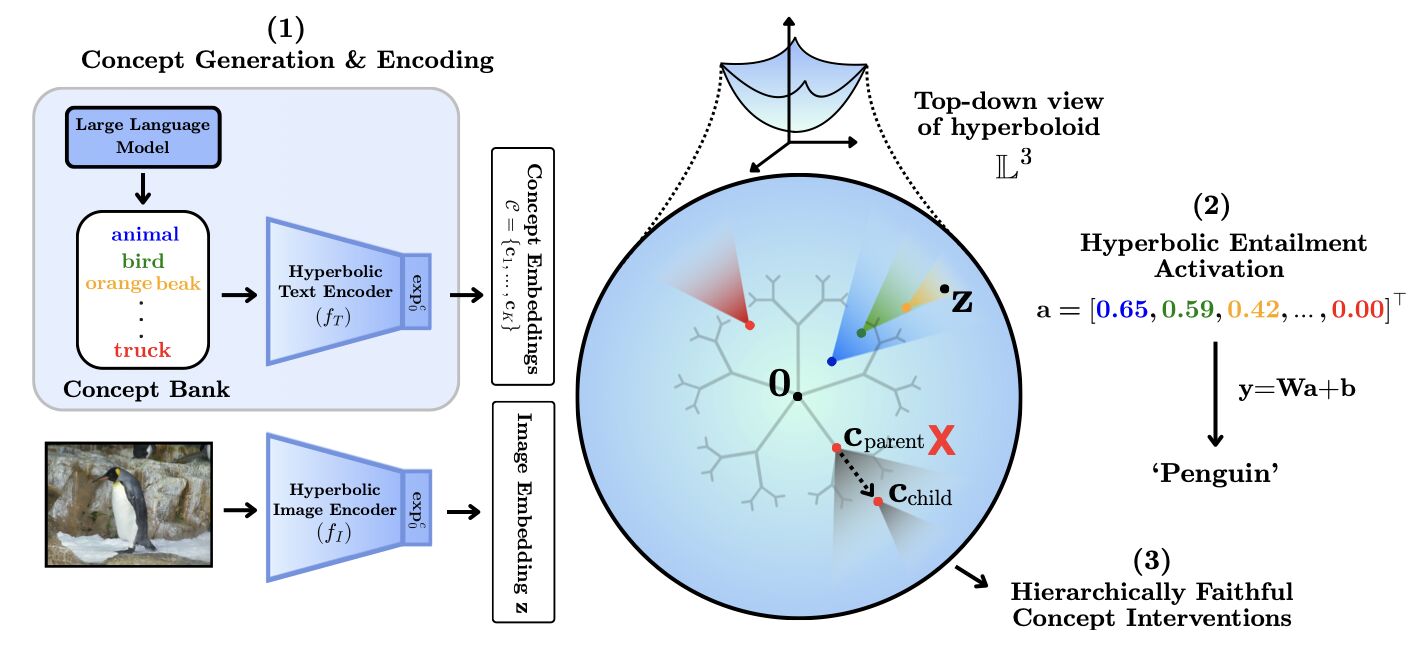
Hyperbolic Concept Bottleneck Models

Hyperbolic Concept Bottleneck Models

Daniel Uyterlinde, Swasti S. Mishra, Pascal Mettes — NeurIPS (Spotlight), 2026

Concept Bottleneck Models make predictions through human-interpretable concepts, but those concepts naturally appear in hierarchies (e.g. 'animal' -> 'bird' -> 'penguin') and current methods don't take advantage of this. In this work, we embed concepts in hyperbolic space so the model can natively capture that structure, outperforming Euclidean models trained on 20x more data and providing a natural way to propagate model interventions through the concept hierarchy.

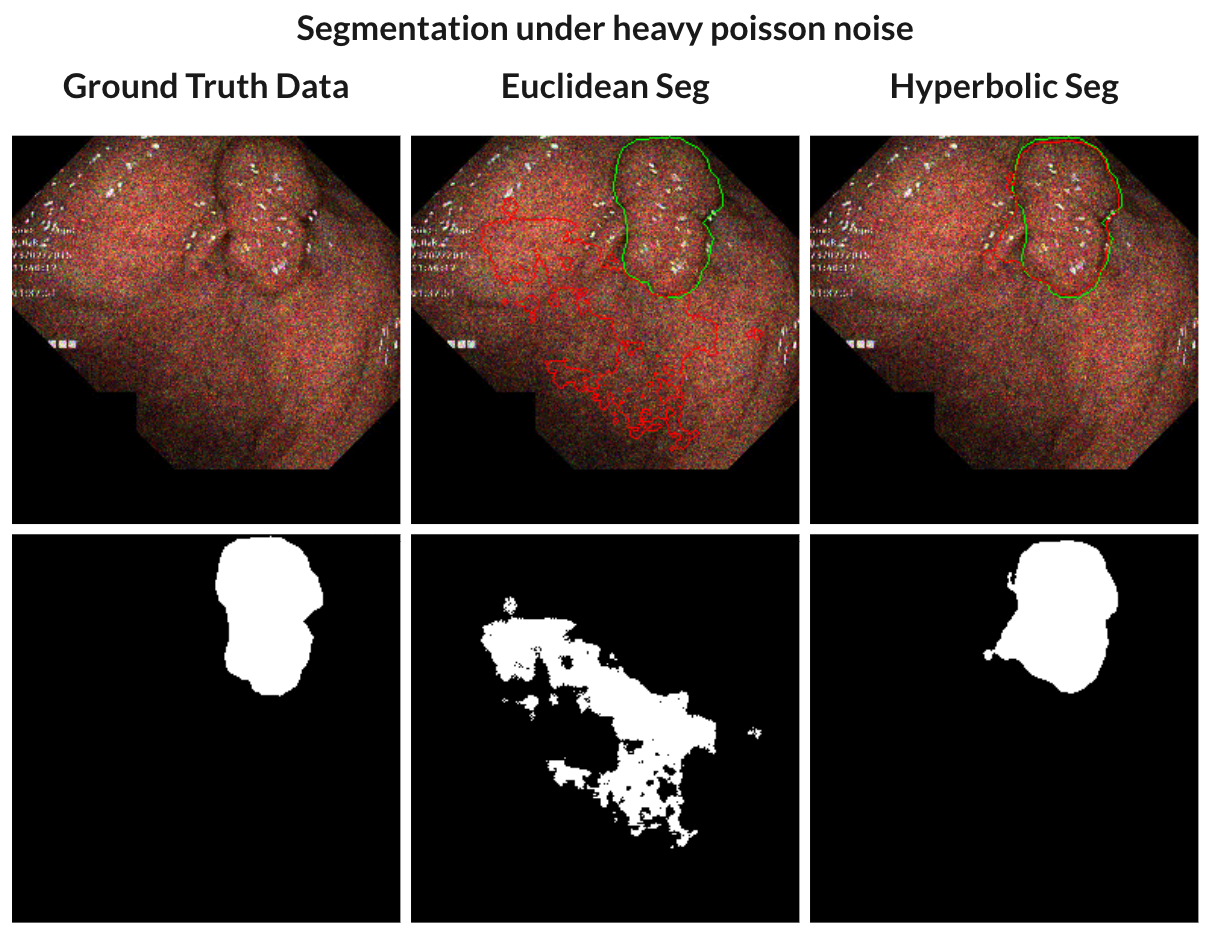
Hyperbolic U-Net results

Hyperbolic U-Net for Robust Medical Image Segmentation

Swasti S. Mishra, Max van Spengler, Erwin Berkhout, Pascal Mettes — MIDL, 2026

We propose Hyperbolic U-Net, with hyperbolic 2D transpose convolution and hyperbolic bilinear upsampling layers that make it possible to create decoders, and Newton's approximation-scaled weight initialization, which ensures norm preservation for all layers at the start of training. Empirically, our Hyperbolic U-Nets strongly outperform standard Euclidean U-Nets across multiple medical image datasets for out-of-the-box noise and contrast shift.

Flow Warping of Self-Attention for Clothing Animation Generation

Swasti S. Mishra, Kuldeep Kulkarni, Duygu Ceylan, Balaji V. Srinivasan — arXiv

We propose FloAtControlNet, a diffusion model-based approach to generate cinemagraphs composed of animations of human clothing. The key observation is that the underlying animation is embedded in the flow of the normal maps. We utilize the flow thus obtained to manipulate the self-attention maps of appropriate layers.

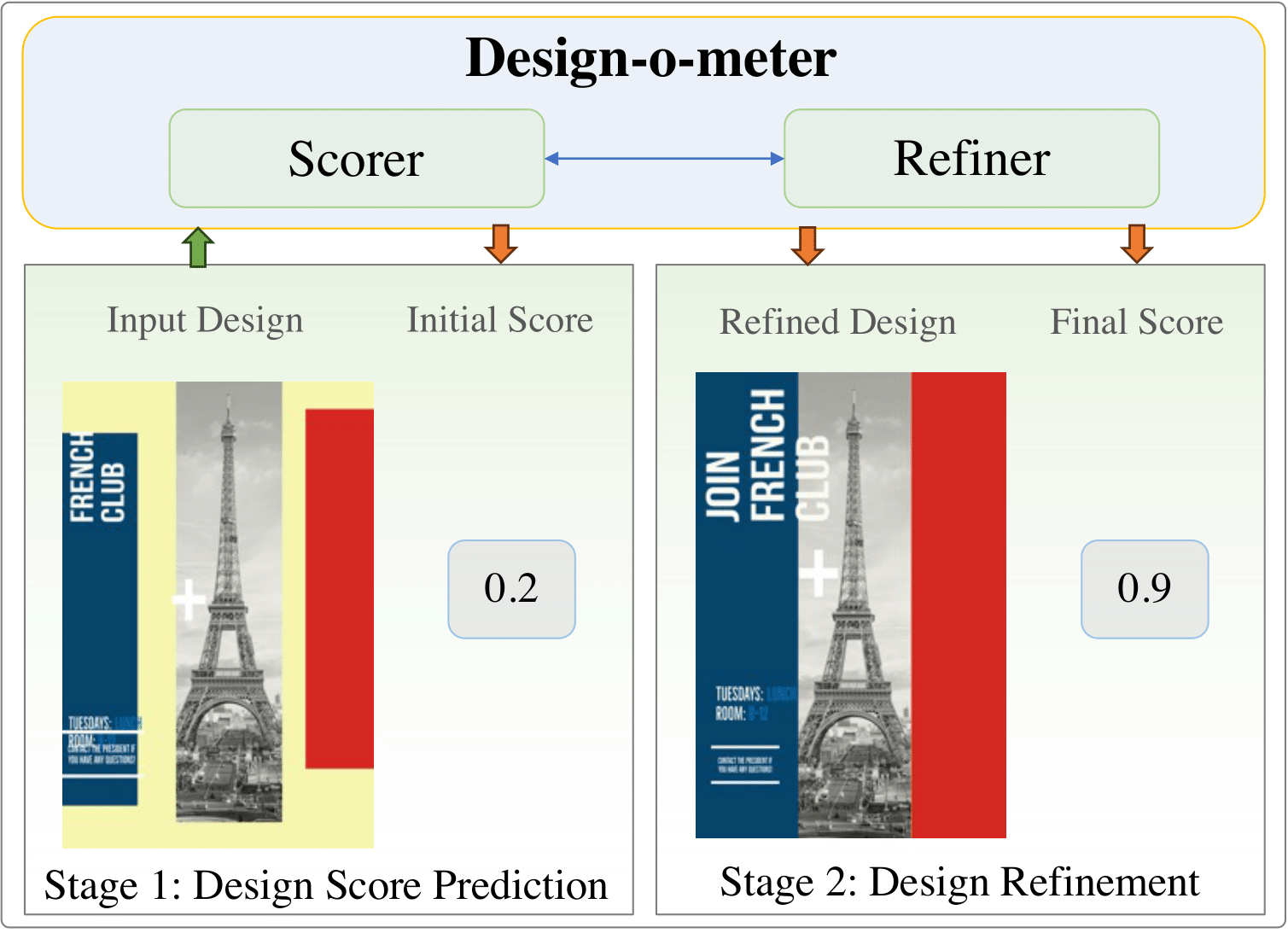
Design-o-Meter

Design-o-Meter: Towards Evaluating and Refining Graphic Designs

Sahil Goyal, Abhinav Mahajan, Swasti S. Mishra, Prateksha Udhayanan, Tripti Shukla, KJ Joseph, Balaji V. Srinivasan — WACV, 2025

To evaluate the quality of machine-generated graphic designs, we introduce Design-o-meter, a data-driven method that scores and refines designs. Our approach outperforms baselines including recent Multimodal LLM-based approaches.

A Deepfake-Based Study on Facial Expressiveness and Social Outcomes

Laetitia A. Renier, Kumar Shubham, Rahil Satyanarayan Vijay, Swasti S. Mishra, Emmanuelle P. Kleinlogel, Dinesh B. Jayagopi, Marianne S. Mast — Nature, Scientific Reports, 2024

As a proof of concept, we test the replicability of past results regarding the positive effects of facial expressiveness (gazing, nodding, smiling) on social outcomes using AI-generated faces via deepfake-based technologies.

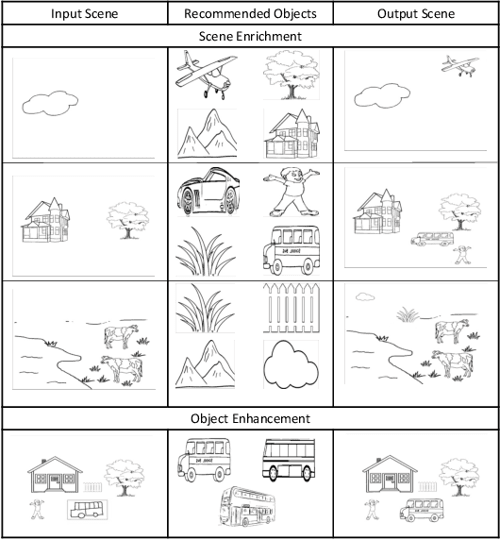
SketchBuddy

SketchBuddy: Context-Aware Sketch Enrichment and Enhancement

Aishwarya Agarwal, Anuj Srivastava, Inderjeet Nair, Swasti S. Mishra, Vineeth Dorna, Sharmila R. Nangi, Balaji V. Srinivasan — ACM MMSys, 2023

We propose SketchBuddy, a framework that retrieves diverse fine-grained object suggestions to enrich a sketch and coherently inserts them into the scene by detecting objects to estimate scene context.

Motion transfer

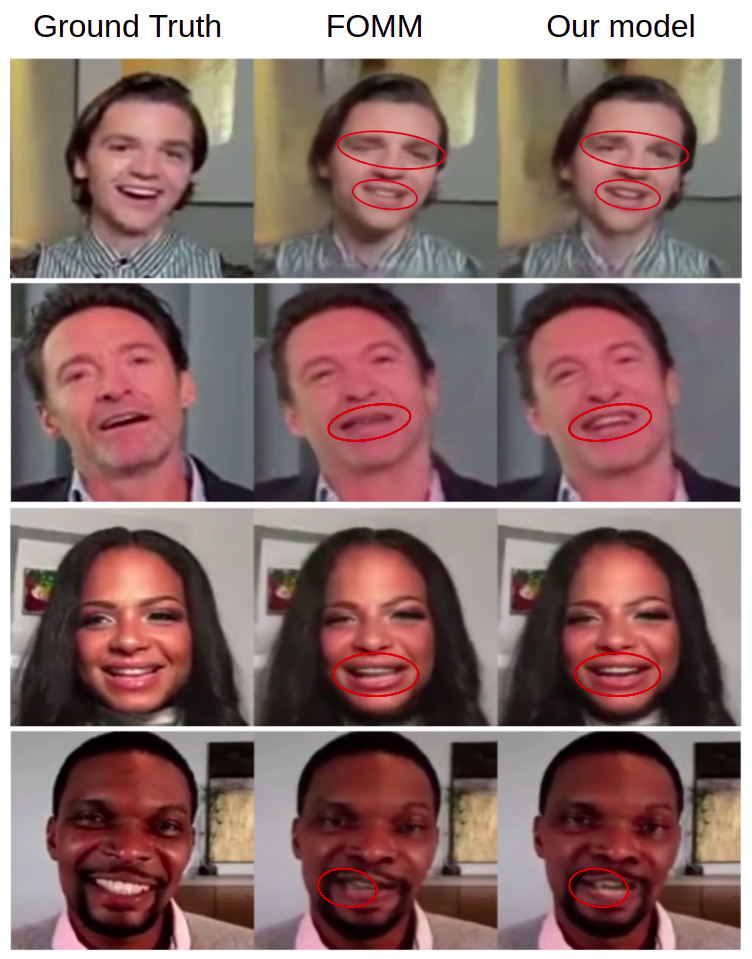
A Hybrid Rigid and Non-Rigid Motion Approximation for Generating Realistic Listening Behavior Videos

Swasti S. Mishra, Kumar Shubham, Dinesh B. Jayagopi — ICVGIP, 2022

We propose a hybrid model that approximates a given motion using both first-order and zero-order motion, accounting for rigid and non-rigid body-based motions to reduce artifacts around the lip and eye regions.

Firm Dynamics and Employee Performance Management in Duopoly Markets

Prateksha Udhayanan, Swasti S. Mishra, Shrisha Rao — Physica A: Statistical Mechanics and its Applications, 2021

We extend an existing firm model to introduce employee motivation and a CEO agent with parameters for leadership and managerial qualities, incorporating the vitality curve to better capture real-world firm dynamics such as the Peter Principle.